
Health
STORM Healthy Energy opens drink shop in St. Pete
By Katherine Langford
Advertisement · Why this ad?
Katherine oversees editorial operations across all six brands. Before joining The Meridan Group, she spent 14 years at the Minneapolis Star Tribune, where she led the metro desk through its digital transformation. She holds a Master's in Journalism from Northwestern's Medill School.
More from Katherine →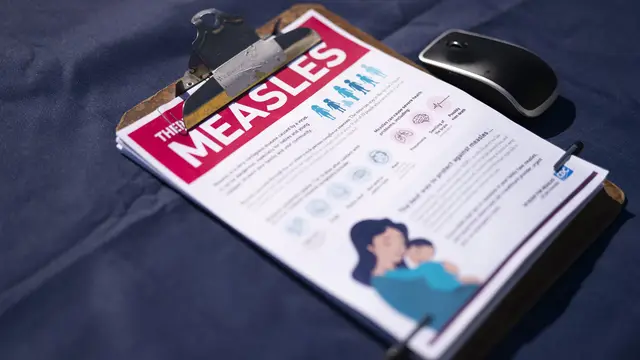
Pennsylvania health officials announced that a fourth person in the state died from a measles-associated illness in September. LiveNOW’s Anna Marsick brings FOX News Multimedia Journalist Peter Cuddihy into the conversation following an interview with Forbes Physician and Senior Public Health Contributor Dr. Omer Awan to discuss what the ongoing outbreak means for public health.
The United States has lost its measles-elimination status after 26 years of keeping the highly contagious disease at bay with vaccines.
There are roughly 5,400 confirmed cases so far this year, already double the 2025 tally.
The U.S. is seeing its worst year for measles illnesses since 1991.
The U.S. has lost its measles-elimination status – a designation it’s held for 26 years – as measles cases surge amid large outbreaks in Pennsylvania, Texas, Utah and other states, according to The Wall Street Journal.
It’s a jarring reversal for a highly contagious disease that’s preventable with vaccines, but health officials expected the U.S. to lose its designation after the Pan American Health Organization met this week.
According to the Journal, the Pan American Health Organization determined measles has officially returned to the U.S. and is continually spreading in the country.
The U.S. achieved measles elimination status in 2000, after decades of vaccination campaigns brought the childhood measles vaccination rate to above 97%. Health experts say a 95% vaccination rate is needed so that when an infected traveler enters a community, so many people are vaccinated that it will not spark an outbreak.
A fact sheet for measles sits on a table at a mobile clinic offering free vaccinations on February 6, 2026 in Spartanburg, South Carolina. (Photo by Sean Rayford/Getty Images)
"It’s a big deal. The decision represents us moving backward," Dr. David Margolius, director of Cleveland’s health department and a leader in a coalition of big U.S. city health departments, told The Associated Press.
The Centers for Disease Control and Prevention wasn’t immediately available for comment Saturday, but CDC Director Erica Schwartz said in an earlier statement that the PAHO’s decision won’t change how federal health officials are responding to measles outbreaks.
"The measles elimination designation is not what protects Americans. Vaccination does. We know where transmission is occurring and we’re working with state and local health departments to reach those communities. Losing a designation doesn’t mean we abandon an evidence-based approach. It means we remain focused on stopping outbreaks," she said in the statement.
According to the Journal, the U.S. will have to stop the spread of measles for at least a year to regain its measles-elimination status. Experts told the news outlet it could take years to achieve.
Canada and the U.K. have also lost their measles-elimination status in recent years.
Measles outbreaks in the US
Measles exploded last year in large outbreaks in Texas, Arizona, Utah and South Carolina.
There are roughly 5,400 confirmed cases so far this year, already double the 2025 tally. This year’s numbers are largely driven by an outbreak in Pennsylvania that has dwarfed the earlier ones.
The U.S. has now seen 10 measles-associated deaths this year, counting two deaths reported Friday — one in Pennsylvania and the other in Wisconsin. It’s the worst year for measles illnesses since 1991.
Before the vaccine was introduced in 1963, the U.S. saw some 3 million to 4 million cases per year. After the U.S. achieved measles-elimination status in 2000, it was reporting fewer than 200 cases in a normal year.
What is measles?
Measles is a highly contagious virus that can survive in the air for up to two hours. Roughly 9 out of 10 susceptible people will get the virus if exposed, according to the CDC Measles first infects the respiratory tract, then spreads throughout the body, causing a high fever, runny nose, cough, red, watery eyes and a rash.
The rash generally appears three to five days after the first symptoms, beginning as flat red spots on the face and then spreading downward to the neck, trunk, arms, legs and feet. When the rash appears, the fever may spike over 104 degrees Fahrenheit, according to the CDC.
Most kids will recover from measles, but infection can lead to dangerous complications such as pneumonia, blindness, brain swelling and death.
Why is measles spreading in the US again?
According to KFF, a health policy research group, there are several contributing factors to the resurgence of measles in the U.S. They include:
Funding and staffing cuts to federal, state and local public health agencies that impact measures prevention and response "Mixed messages" on measles and vaccines from federal health officials in the Trump administration, including Health Secretary Robert F. Kennedy Jr.
Increased public skepticism about measles vaccines
As health secretary, Kennedy has decreased the childhood vaccination schedule, reshaped a key vaccine advisory board, and praised Trump’s executive order calling for spacing out the measles, mumps and rubella (MMR) vaccine. The executive order runs counter to medical groups’ recommendations, and likely would result in fewer children getting fully vaccinated, experts say.
Trump claimed earlier this year, without evidence, that the MMR vaccine — which is credited with saving millions of lives globally — is possibly "quite lethal." Last year, the childhood vaccination rate fell to about 92% nationally, and was much lower in certain states and certain communities.
This report includes information from The Wall Street Journal, The Associated Press, the Centers for Disease Control and Prevention, KFF and previous FOX Local reporting. FOX's Stephanie Weaver and Daniel Miller.
Palm Harbor, Florida
Health
Saturday, November 14, 2026
4 min
By Katherine Langford

By Katherine Langford

By Marcus Chen

By Marcus Chen